AI won't fix a process you can't see
Most failed AI projects were never AI problems. They were visibility problems that got automated.
Most failed AI projects were never AI problems. They were visibility problems that got automated.
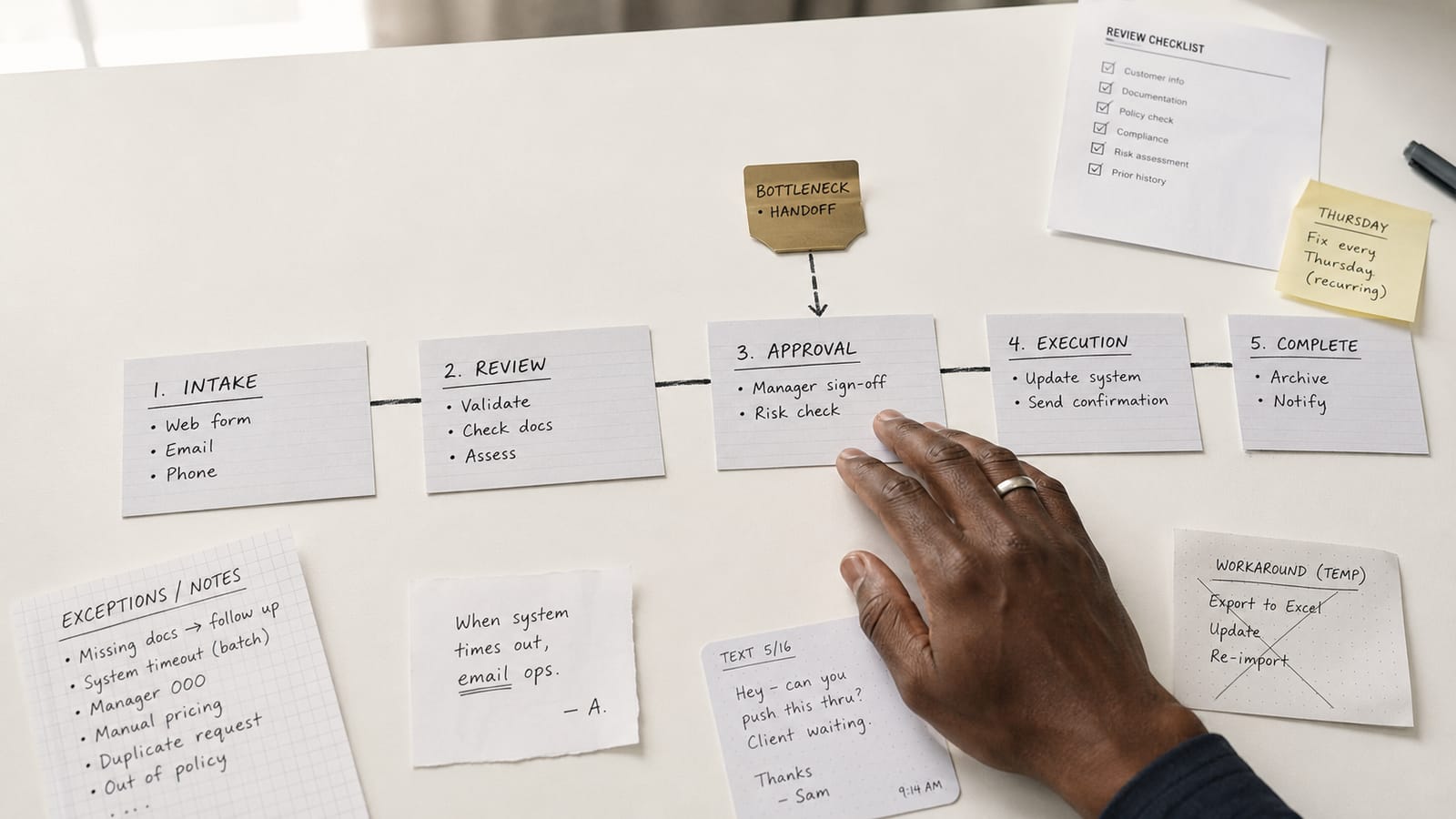
Here is the pattern. A company feels the pressure to "do something with AI." Someone picks a tool, points it at a workflow, and waits for the time savings. Six weeks later the tool is quietly abandoned, and the conclusion is that AI isn't ready for their business. The real issue is simpler and less comfortable: nobody could describe the workflow the tool was pointed at. Not the version in the SOP document. The real one, with the exceptions, the workarounds, the approvals that happen over text message, and the one person who quietly fixes everything on Thursdays.
AI is an execution engine. It does exactly what the process tells it to do, at speed, without complaint, and without judgment about whether the process makes sense. If the process only exists in fragments across five people's heads, the AI is executing fragments. You did not automate the operation. You automated your blind spots.
Map before you automate
The order of operations matters more than the model you choose. Before any automation decision, you need answers to unglamorous questions. Where does work actually enter the business? Who touches it, in what order, and where does it sit waiting? Where do decisions get made, and where do they get remade because the first one didn't stick? Where does the process on paper diverge from the process in practice?
This is diagnostic work, and it is the least skippable step in any AI effort. It usually surfaces two uncomfortable findings. First, a chunk of the workflow you wanted to automate shouldn't exist at all. It's compensation for an upstream problem, and automating it just makes the compensation faster. Second, the steps that genuinely deserve automation are rarely the ones leadership guessed. The guess is usually the visible annoyance. The real cost lives in the invisible handoffs.
There is a payoff that has nothing to do with AI: once the process is mapped, humans run it better too. Visibility is the first step to control, and that is true whether the next actor in the workflow is a person or a model.
What this looks like in practice
I run operations for a living, and I build AI systems on top of the operations I run. The sequence never changes. Trace how the work moves, end to end, from the moment it enters the business to the moment it's done. Write down what actually happens, not what the org chart implies. Only then decide which steps a machine should own.
When I built an AI-assisted system across a nine-platform commerce stack, the AI build was the fast part. The slow part, and the part that made it work, was mapping how work actually moved between those platforms and the people around them: where orders stalled, where data got re-keyed by hand, where a status lived in one tool but the decision got made in another. Every gap the AI eventually closed was found during that mapping, not during the build.
The same holds at any scale. The businesses that get real returns from AI are not the ones with the biggest budgets or the earliest access to new models. They are the ones that can hand the machine a process worth executing.
So before the next AI conversation in your business, run a simpler test. Pick one workflow that matters and ask three people to describe it. If you get three different answers, you don't have an AI opportunity yet. You have a visibility problem. Fix that first, and the AI decision gets easier, cheaper, and dramatically more likely to hold.
Run the three-answer test
One workflow, three people, no coaching. You'll know by the end whether you have an AI opportunity or a visibility problem.
THREE DIFFERENT ANSWERS ISN'T A FAILURE. IT'S THE CHEAPEST DIAGNOSTIC YOU'LL EVER RUN.